
From The Daily News
By PAT LEONARD
In Week 11 of the 2004 NFL season, Tom Coughlin told future Hall of Fame quarterback Kurt Warner he no longer would be the Giants’ starter. The team was turning to that year’s No. 1 overall draft pick, Eli Manning, despite a 5-4 record through nine Warner starts.
Warner was a two-time league MVP and Super Bowl champion who had signed a twoyear contract and hoped to play at least a full season and reignite his career. At 33 years old, he was a much better player than the rookie Manning, 23.
Still, Warner understood. Manning was the organization’s future. “Even Tom Coughlin told me as much: ‘It’s not because Eli’s better right now. It has
nothing to do with you. It’s about how do I prepare this team for the future,’” Warner, now an NFL Network analyst, told the Daily News in a phone interview last week. “‘You’ve helped us win and changed the perception,’ (but) reading between the lines, … I got the sense (we) didn’t think we were a contender, so it made more sense to make a move now. We can get there, but it’s not gonna be with Kurt Warner. It’s gonna be with Eli Manning. That’s our future. We’ve got to ride with him at some point.
“You saw that the last seven games, (Manning) really struggled,” Warner recalled of the Giants’ 1-6 finish down the stretch. “He wasn’t ready to step in and play and wasn’t where I was as a player. But they weren’t playing for those seven games. They were playing for years later. And getting hit and dealing with that frustration, without a question, made Eli better and sped up his process.”
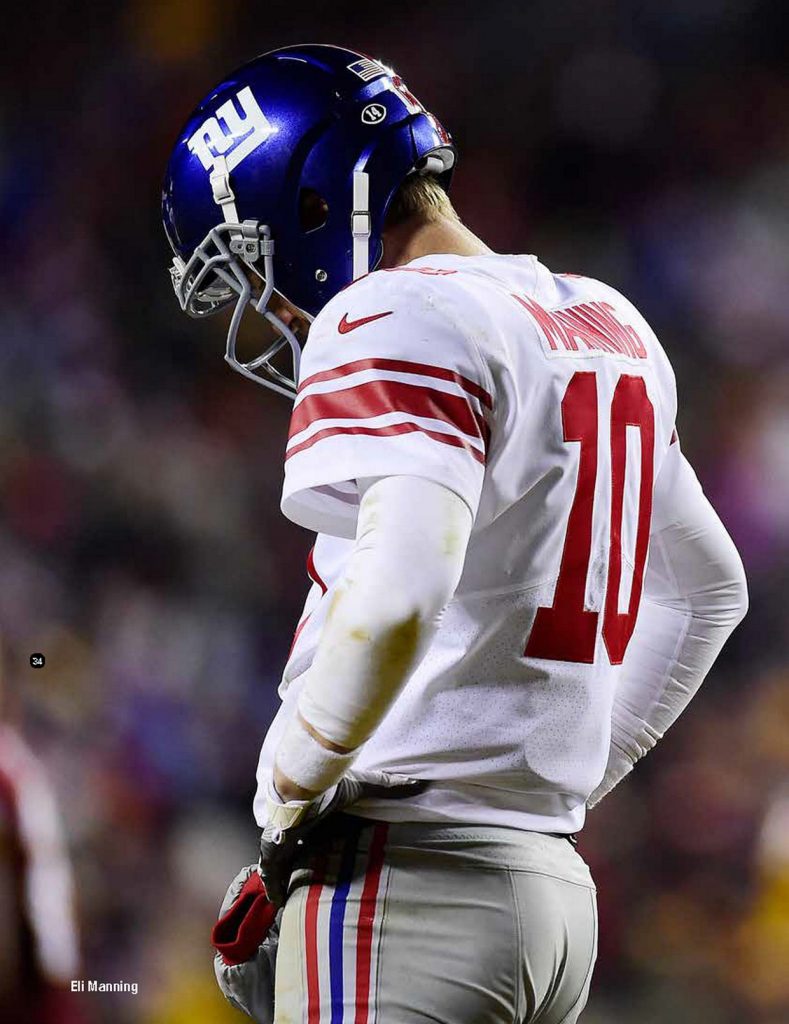
Fifteen years later, Manning, 38, is the veteran looking over his shoulder as the Giants’ No. 6 overall pick, Duke QB Daniel Jones, reported Monday with fellow rookies and select veterans to open training camp.
Warner is the first to point out that Manning’s situation is obviously different from his own in 2004, given Manning’s lofty status within the organization as a two-time Giant Super Bowl MVP.
“The difference is Eli’s solidified as one of the great Giants, so this isn’t like, ‘He’s not gonna be here, so let’s move to the young kid,’” Warner said. “Like, I was a stop-gap guy.”
Still, the Hall of Famer believes the Giants will be, and must be, “cautious” with how they handle the transition to Jones, whether they’re planning it for midseason 2019, 2020 or beyond.
“If Daniel Jones is better, Daniel Jones should play,” Warner said. “No disrespect to Eli, but if you feel that’s the case, you have to pass the torch. Now that’s not how I feel, though. I feel Eli can be successful; he just needs help around him. Daniel Jones is your future. No doubt about that. But you have to be sensitive to who the guy he’s replacing is.”
Warner would know. “If it played out like Eli and me in 2004, I think it would be an ugly situation. Because if the young guy comes in, doesn’t play well, looks really bad and (you’ve benched) this guy who means a lot to the organization, now it looks awful. But you also have to be sensitive to not letting it go too far the wrong way either: If Eli’s not playing well, it’s obvious, and everyone knows Daniel needs to be playing.
“(But) especially with Eli Manning, he deserves the right to have every opportunity to finish this thing the way he wants to finish it, if he can still play and be successful and is even with Daniel Jones or a little bit better.” What a franchise quarterback deserves in this situation, though, can be subjective and often irrelevant.
CHANGE HAPPENS FAST
Phil Simms was released prior to the 1994 season despite being the first Giants QB to win a Super Bowl. He was the Super Bowl XXI MVP to cap the 1986 season, and a two-time champion coming off a playoff appearance in 1993. Owner Wellington Mara even disagreed with GM George Young’s final call.
Mara read a statement when Simms was let go, calling it “a day of overwhelming sadness.” Still, Young cited Simms’ fit within the NFL’s new salary cap and made the switch to 1992 first-round supplemental draft pick Dave Brown, 24, out of Duke. Simms, 38 at the time, never saw it coming, though in hindsight he recognizes one sign had been right in front of his face.
“I never thought about how we have this No. 1-round draft QB and we need to make a transition and he needed to play,” Simms, 63, told the News on the phone Sunday evening. “Even with the age difference, I didn’t realize it until after … I never looked at it like he’s here to take my job.”
Then in 2004, when Manning replaced Warner after three Giant losses in four games, wide receiver Amani Toomer called Warner a “scapegoat” and said he was “surprised” because “it’s not all Kurt.” As Warner said, though, Coughlin told him directly: it wasn’t about what Warner had earned or
deserved.
It’s natural to ask, then, why Manning would help groom Jones to take his job.
Making Jones a better player would give the Giants one more reason to make an earlier-thanexpected change. And the organization has proven in the
past that superior ability isn’t even a prerequisite to go to the rookie anyway.
Pat Shurmur and the Giants have been extremely careful, therefore, to say that it is not Manning’s job to teach or mentor Jones.
“I told this to Eli a couple times already; it’s not his job to teach the next quarterback that comes in here,” Shurmur said after drafting Jones. “It’s his job to be the very best player he can be, and then the quarterback that we bring in, it’s his job to be smart enough to learn from Eli.”
Warner, however, didn’t approach 2004 with a reluctant attitude toward teaching Manning, and he doesn’t understand why any team wouldn’t ask a veteran QB to mentor the youngsters now.
“I wish more teams would go, yeah, I expect Eli and (Denver’s) Joe Flacco, my veteran QB, to help everyone get better,” Warner said. “If it’s something they can help everyone on our team to get better, I expect that. When I signed on the dotted line, there wasn’t any fine print to do anything to make us better only when you’re the starter. It’s just stupid.
“I’m part of a team and to make the team better. That’s your role, your job, that’s what a leader does,” he added. “(If I were on the Giants this year) I want to make Daniel Jones better. Let’s say he doesn’t beat me out but I get hurt and Jones goes in the next four games. I want him to win those four
games so I can come back in and we can go win a championship.
“Sometimes,” Warner concluded, “you lead well enough and get guys prepared well enough that you lose your job.”
MENTORING THE NEXT GENERATION
Simms can relate. He didn’t shy away at all from forming a close relationship with Brown. “Dave and I didn’t have a good relationship; we had a great relationship,” Simms said. “We played golf, we talked all the time. It was fun being 38 years old and having young kids around playing music in the locker room and saying to you, ‘Come on, what’s this song, Phil?!’ Ya know? And even for Eli, it will be this way. As an older quarterback, you want to see if young QBs can hang with you — when you’re working out, when you’re throwing, when you’re learning the playbook. All of it.”
Simms said he “used to stand on the field after some practices and watch (Brown) throw and work with him.” He also remembers Brown would
grab the game sheet after road games and ask him questions on flights home.
One night, Brown saw better stats next to Simms’ name than he’d expected. Simms laughs recounting what Brown asked him next.
“How did you put up these numbers? I didn’t even think you were playing that well,” Brown said. Simms didn’t take offense. He explained how late in a game that already had been decided, he’d made smart, strategic decisions to gain some yards and pad the stats a bit.
“Never at the expense of the team, though looking back, I wish I’d have done that more often,” Simms laughs. “But (Brown) looked at me and he goes, ‘Do you think I’ll be able to do that?’”
Brown wanted to know, and Simms was happy to share. In Warner’s case, before his incredible underdog story from undrafted NFL afterthought to Hall of Famer took off in St. Louis in 1999, veteran Trent Green was on track to be the Rams’ starter.
And Warner said he never stopped asking Green questions during practice about Mike Martz’s offense. “Every time (Green) made a throw or read I’d say, ‘Why did you do that?’” Warner said. “I probably wore him out. He was probably sick of me talking to him, but he was so huge in my development.”
Warner’s experience as the veteran in a Giants QB room with a young Manning, though, wasn’t the former Rams great imparting constant wisdom to a wide-eyed rookie. Part of that was due, Warner said, to Manning’s less outgoing personality.
“The situation there was a little different with Eli from the standpoint of a) Eli’s personality was introverted, he was a quiet kid, cerebral guy, didn’t ask, didn’t talk a lot, at that time almost seemed a little overwhelmed, not that he was,” Warner recalled. “I was open to doing anything and everything, but because of his demeanor, there wasn’t a lot of, ‘Kurt, what do you think here?’ or ‘What are you seeing?’ from (Manning). Had he asked, I would have done anything he’d asked. But we always talked in meetings, and when he was starting, we did all the normal stuff.”
Warner also said, though, that he wasn’t going to force a mentorship on Manning because he knew the young Eli hailed from one of football’s royal families. He had plenty of advice at his fingertips already.
“He’s got a dad and brother that played in this league, and he has those guys as mentors, and I always felt respectful of that.” Warner said. “I’m not gonna push envelope and make Eli do what I’m doing because he’s got these other means of knowing how to prepare. And I tried to be respectful of that.
“So because of his personality and his background, I tried to do everything I could, but it wasn’t as over the top as other guys I worked with,” Warner said. “With some guys I’d say hey come watch film, let me talk you through it. Or with certain guys I’d always be in the background, and after a rep I’d
grab them and say, ‘Ok, why did you do that?’” It wasn’t quite the same with Eli.
Manning hasn’t declined to mentor Jones, even if he’s not exactly volunteering for a title change. “I think I’ve been doing that the last 11 years, 12
years,” he said in May of mentoring younger QBs. “I don’t know when you become a mentor, ya know, when that’s official. I think when you’ve been in the league longer than any other guy in the quarterback room, you should be a mentor in that sense where you know a little bit more and can be helpful.”
Manning did add, however, that “it’s not necessarily your job to do it (as a veteran). It’s a little bit on Daniel being in there listening and asking questions.” And that’s interesting, because the Giants seem to be asking Jones to be much more outgoing, inquisitive and active in soliciting Manning’s help than he was himself seeking Warner’s advice in 2004. Still, Warner has no doubt that Manning will do everything he can to help Jones, whether or not it’s being asked of him officially. “Eli’s been nothing but class, but yeah, I expect him to help Daniel Jones anywhere he can,” Warner said. “Does it mean spending 40 hours extra? No. It means show Daniel how to be a pro, how to be a champion.
“I don’t care how many coaches there are,” he said. “Very few people have the experience I did (as a highly-successful NFL quarterback). How many
guys have been in my shoes, in those situations, that can teach Jones, things that I can teach them? Whether it’s QB coach, an offensive coordinator, can they teach him what I can? Probably not. Even though yeah, part of it is the coach.
Simms said that Manning, regardless of whether he’s officially labeled as Jones’ mentor, will naturally become a teacher for the rookie.
“All these (Giants QB transition) situations are a little different,” Simms said. “Kurt was different. We all knew why he was here (in 2004). Eli is a little different, too, though Eli’s situation is a little more consistent with mine. And Eli will be just like me and almost every QB: It’s in you. You’re gonna share info and talk about things that are gonna help a young QB. It’s like you’ve got a secret, and you want to tell somebody.
“There are so many great things an old QB can tell young guys, not always about what you did but how you’re approaching it mentally: how not to get down after you throw an interception, for example,” Simms added. Just like Warner, though, Simms believes that Manning “deserves” one last opportunity to prove he’s still got it as the starter before he steps out of the spotlight. “He does deserve another chance,” Simms said, “to see if they can do something: the consecutive start streak, two Super Bowls and MVPs, his loyalty, the way he’s conducted himself. Everything. Yes, he deserves it.”
JONES READY TO LEARN
Jones said this spring that he’s learned a lot just by watching Manning’s “routine and daily preparation, how he prepares for practice, how he reviews
and learns from practice.”
The rookie called the quarterback room “a collection of people,” including Manning, Jones, Alex Tanney and Kyle Lauletta, with a constructive dynamic of “always bouncing ideas off of each other and hearing everyone.”
Jones isn’t acting like some unprepared puppy dog desperate for knowledge, though. He’s trying to push the envelope and compete for playing time. And there’s no reason for him not to.
Shurmur encouraged Jones at the end of the spring offseason program “to be ready to play day one,” and that added some heat beneath Manning’s seat even as the Giants call him their Week 1 starter. So Shurmur’s words are proof the coach has no problem putting healthy pressure on Manning to perform.
The Giants’ decision to bring Manning back in the first place, though, and their reticence to call him Jones’ mentor, also may represent their sensitivity to avoid repeating — and in their minds, possibly undo — the damage done by their botched Week 13 quarterback transition of 2017.
Co-owner John Mara made the call then, and he regrets it. GM Dave Gettleman technically now has final football say with the 2019 Giants. But Mara remains involved, so there will not be a scenario like Simms’ in 1994, with a GM releasing a player while the owner publicly opposes the move.
“You have to be more cautious than they were in ’17,” Warner said. “That to me was just the wrong move for so many different reasons. First and foremost putting in Geno Smith, that wasn’t your future.”
STEPPING ASIDE … WHEN IT’S TIME
A large part of this will be on Manning, too, however, to recognize and accept graciously when it’s time. Rewind to Week 14 of his 2004 rookie year, in fact, and he’ll find a perfect example of how to do so from Warner’s actions that day in Baltimore.
An overwhelmed Manning was a disastrous 4-of-18 for 27 yards, two interceptions, and one of four Giant lost fumbles in his fourth career NFL start. The Giants suffered a 37-14 blowout road loss to the Ravens, and when Coughlin replaced Manning with Warner in the fourth quarter, the veteran who had been benched in Week 11 promptly led a touchdown drive and finished 6-of-9 for 127 yards.
Before a quarterback controversy could even begin, however, Warner recalls: “I made sure right after that game I went to Coughlin and said, ‘You need to go out and tell the media that Eli’s our guy. You need to go and establish Eli had a bad game, just like anybody. I told Tom you’ve got to make that statement right now, because I understood.
One factor in Warner’s decision to cede to Manning was that he knew such a successful pass-heavy attack late in a blowout loss, while it allowed him to show fans “the Kurt Warner of before,” wasn’t a realistic part of the Giants’ identity.
“When I came into that game and we were down, for the first time that year I got to play football the way I play football,” Warner said. “It was good for me because it was nice to make that statement to everybody in the league, ‘Hey, I can still do this. They haven’t asked me to do this.’ They were good sequences for me. But it was a bit deceiving for fans or people who thought maybe we could have this. It was never gonna be that kind of offense in New York.”
More than anything, though, Warner said, “After that game, though, I had to put myself in Eli’s position, not just look at mine.”
“I thought if I’m Eli, what would I need in this situation?” Warner remembered. “I would need that vote of confidence from my coach. ‘He’s still our guy.’” So Warner, who still had another Super Bowl appearance and five more seasons with the Arizona Cardinals in him, told Coughlin to go back to Manning.
Fifteen years later, Manning is telling ESPN he wants to play past the 2019 season, his final year on his current contract with the Giants. But a transition to Jones as franchise quarterback looms.
Manning doesn’t have to like it, and he is receiving every opportunity to delay the inevitable. It’s getting closer to the time, however, when what he wants or “deserves” won’t be a factor. And like Simms and Warner before him, he’ll have to accept it and understand.

