
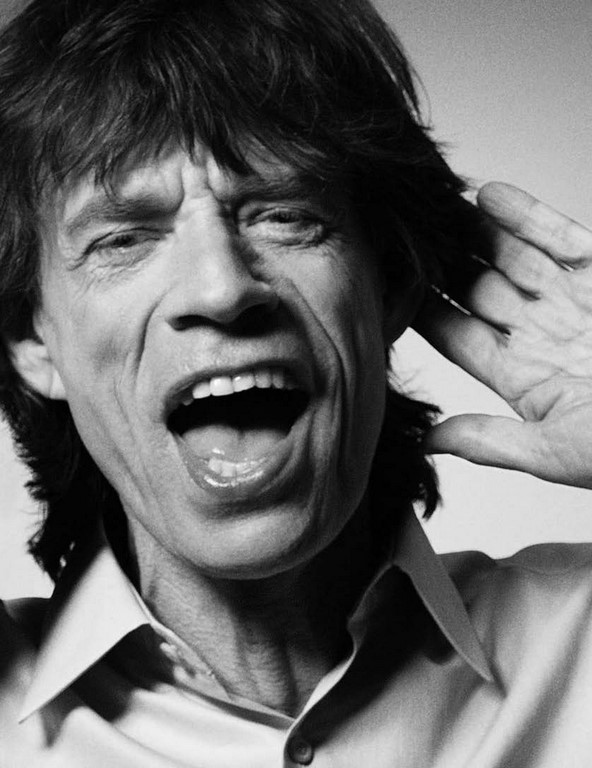
MICK JAGGER
The Rock Legend
There’s no such thing as what really happened, and no-one can really remember what happened!
In the flesh, Mick Jagger presents a beguiling mix: part Elfman, part Monolith. He is, after all, one fifth
of the Rolling Stones. Or a quarter, or even a third, depending on when you first acquired a taste for
the band – or feel best represents their shining hour. He is, irreducibly, half of the Glimmer Twins, the
songwriting/producing/mytholigising team comprising himself and Keith Richards, together the beacon
of rock’n’roll that became a baton charge, and then a ticker-tape parade.
Today he is simply Mick Jagger – the mind, manners and, latterly, mediating element of the Stones:
largely responsible for Stones In Exile, a long-form documentary released on Netflix and recording,
in retrospect, the protracted, fractured recording of their tenth and only double album, “Exile On
Main St.” A seemingly tortured process for Jagger on both accounts, each bears examination and reexamination
respectively.
Can I offer you some water?
Mick Jagger: I’m having tea. I’m trying to keep awake. I’m still jet-laggedslightly. It’s funny how it works,
it comes like, first day’s fine, second day you get tired around now.
Which way have you come?
From LA. I’ve been mixing the extra tracks for “Exile On Main St.”.
How many?
Ten or eleven
Who holds the sacred ark of knowledge about the Stones?
I don’t. I had to go and look in those books which have been done over the years of the recording dates.
And of course they’re not 100 per cent accurate – and they say they’re not. But if you read more than one of them,
it’s like a restaurant: if three people tell you it’s good you know it probably is good. But the guys at the record
company had a guy who really knew about the history of the Rolling Stones. And he’d send me these bootlegs and Keith would go, “oh that’s a really great one, I love that one”. But then after a while I sort of sussed that as much as
I wished they were – they were not from the “Exile” [sessions]. So then you have to decide what is. So I had to sort
of define “Exile On Main St”. Because it wasn’t all recorded in one go in Los Angeles. So it’s got a lot of locations.
That’s a sort of philosophical argument, isn’t it? How far back do you go?
Exactly. So I said, ‘so what’s the first track that was recorded that was used’ – it was actually Loving Cup
which was recorded in July 1969 or whenever – so anything from July ‘69 until the album was mixed is in “Exile” period. So I just picked tracks from that.
“Exile” seems to represent a total change in the way you and the band worked – am I right in assuming that?
Not really. The more I thought about it the more I think it wasn’t at all different. Because the thing about
“Exile” is it was recorded probably over the longest period of a proper Rolling Stones studio album.
That’s not completely true, cause “Tattoo You” was as well. But it was a very long period anyway.
Much longer than all the previous ones. So it’s over three years recording time. And we recorded it in
different ways. We recorded it in Olympic Studios. And we recorded in my house in the country in England
where we recorded some of “Sticky Fingers”. And we recorded some in Nellcôte which was Keith’s rented house in the south of France, and we recorded some of it in Los Angeles. So it’s got a lot of locations.
Had you always planned to make a double album?
I’ve no idea when that decision was made. I think it was probably that we knew we had a lot of nice tracks that
we’d recorded in England that we wanted to release and then didn’t ‘cause we had all that trouble with Klein.
So we wanted to wait until that was all sorted out, I think, before we released any more. I think that was part of it.
But at the same time “Sticky Fingers” had been released…
It was just released while we were starting, yeah.
And it had a fantastic reception.
Yeah it was very good.
So you were under no immediate pressure…
I’ve no idea why we went back into the studio so quickly. I’ve no idea why we didn’t go on tour then.
One of the reasons, I think, was because Keith had so many drug busts he couldn’t get a visa that was one of the other problems. I think myself too, but I.
I read somewhere too that you couldn’t go into the States at that point.
And then you look at the calendar and you see I went then – there I am. So it can’t be that. But I think
there was a difference between visiting and going to do a tour. They would give you a very limited permit to, say,
go for a couple of weeks, but they wouldn’t let you work. And I think that was the problem. And
that’s probably why we didn’t go on tour. But I’m making that up.
But as I understand it, the central portion of the recording process that has gone down in history was the Nellcôte sessions…
Yeah, there was a lot recorded there. As I say, it isn’t true that it all was actually. We were there the most time,
but what we really produced out of that, and a lot of what we did there, was actually recorded first in other places.
In other words, it wasn’t the first time we’d recorded it. I’m not saying we didn’t do anything in Nellcôte, but when you actually go through this process and look at it all, you realise that, although we were in Nellcôte a lot of the time, it wasn’t really only about that; the bit in Los Angeles was enormously productive and gave “Exile” a lot of the feel it never had when it was left in Nellcôte. And none of the vocals were done there so it’s not true to say that it was only Nellcôte.
Does it frustrate you then, that Nellcôte has become so emblematic?
thinking about, “oh we’re going on tour”. Which were very popular songs of the period – you know, road songs,
about girls on the road, going on the road. So I don’t hear the kind of confused, dark lyrics that some people hear, personally. I hear all kinds of other funny things. I hear other things but I don’t hear those. It’s a very mixed bag of things. One of the things about “Exile On Main St.” is, it’s a very mixed bag of musical styles: it doesn’t include any pop music – there’s almost no pop in it. There’s no Angie – I know that’s later – but there’s no pretty tunes. There’s no great ballad on it, in fact there’s almost no ballads. There’s Shine a Light, but that’s a gospel song really. There’s a bit of country, there’s a bit of blues, straight covers, kind of hard rock. But all and all, it’s a kind of exhibition of styles.
You’ve spoken before how it’s not your favourite record particularly…
The thing about it is, it’s a great album as an album. But when you start taking the individual songs out
there’s not that many stand-outs. Let’s take a record like “Some Girls”, you’ve got Miss You and Beast Of
Burden. These are kind of very focused songs. Whereas “Exile”, when it came out, wasn’t very successful because “ was the only single of any note. It didn’t have three singles on it which you’d still rather like in an album.
But as an album…
It’s very interesting.
Because it’s less well-known?
And also because it’s sprawling and quite long; you couldalmost go into it and find something you don’t know, which always interesting in a piece. Also, as we discussed, it doesn’t have any unity of time and place, it really doesn’t.
In other words, it’s not a concentrated period of time. If you make a film in a concentrated two month period,
you’ll somehow encapsulate what you felt in that period. Whereas if you record something over a three year period, you won’t. You just won’t. But you’re going to get something else.
Can we talk about the Dominique Tarlé pictures?
Yeah they’re very famous.
What’s more powerful, hearing yourself as a young man singing as a member of the Rolling Stones, or seeing yourself as a young man in a Dominique Tarlé photographs or Robert Frank photographs?
The photographs, they’re interesting. But when you actually hear yourself singing and talking, I’m telling Charlie what beat I want, it’s quite funny. It very much puts you in the moment more than any picture, the picture doesn’t put youin the moment because it’s a picture in a book. If you’ve got headphones on and you’re hearing what actually
happened, the soundscape of it, it’s like, so immediate.
That seems to be an understatement.
Yeah, up to a point. But I think it got organised as it went on. At the beginning it was very disorganised.
We got more organised. There’s the musicians, but there’s also the tech, and if the tech’s not working it doesn’t matter what the musicians are doing really. It makes the musicians really frustrated. And we took ages and ages
and ages to get it to work. And then, of course, you had all these hangers on and all that.
But did the fact that it was Keith’s property, running on Keith time,
affect the actual dynamic of the process?
Well yeah, it affected us up to a point, but we still carried on working if Keith wasn’t there. That’s what Keith says anyway. I heard an interview with him the other day and he said, “I used to wake up and I heard that they were playing and I used to say, ‘blimey, they’ve been playing without me all night’”. And if you look, the thing about “Exile” is there’s a lot of musicians. You’ve got two piano players, you’ve got two horn players, Jimmy Miller
playingdrums sometimes. You’ve got all kinds of combinations going on – Mick Taylor playing bass if Bill wasn’t there. I mean, the thing about records is, you can make records with two people. So it doesn’t really matter if everyone’s not there.
So you think that side of it’s been slightly overstated in the constant retelling of the myth?
Yeah. I mean, on these outtakes I’m obviously not there on some of them, though I come in half way through.
Or Mick Taylor’s not there. And on the tracks we recorded in Olympic, Keith’s not there. But no one actually reads thesheet or anything so they think, oh yeah he was on it. But it was all rather chaotic. And we made it more difficult for ourselves by making it a double album. That’s just doubled your workload.
It seems to me you’ve never really had a rosebud moment as a band. You don’t want to go back
to the very beginning which is something that other artists have been prone to do over the last
ten or so years, to go back and find that kernel of their youthful enthusiasms and make an album
in front of a fire playing an acoustic guitar or whatever. It almost seems to be a function of bands now that they put their stall in order. They’re taking possession of everything, every last… Doesn’t that interest you?
No it doesn’t. I just like to move on and get on with things. And I was very reticent about having to do all this work on Exile. I don’t mind doing it. I’m not sure if I’d ever want to do it again though. I think it’s all fascinating and I think “Exile” was like an interesting time and everything, but it’s very difficult to try and explain to people.
Because people have their own opinion and you don’t want to change their opinions of what they think. Because it’s much easier to go and tell the story of “Exile”, the story you think that they would prefer to hear. But the more you delve into it yourself then you find out actually what happened on the day. You think, “oh I see what actually happened”. It isn’t really like people say it never happened like that. Or – that happened, sure.
Didn’t they take a lot of drugs – yeah, but they always took a lot of drugs, that’s not new. But that didn’t happen on that day or that wasn’t even recorded in that way, and that wasn’t even recorded there and how about… So you sort of discover those things. But ultimately it’s not really that interesting.
A few years ago you famously returned your advance because you couldn’t quite remember…
I just didn’t want to do it. Because, to be honest, doing tw0 years on a book about your life is very hard work.
And it’s also not much fun. Because that’s two years of your life you’re not doing something new.
I’ve been like four months on this “Exile” thing between this, that and the other, and getting this documentary
film made, finding old tracks and old films and all that. And talking about how’s it going to be promoted.
And what’s the point? I could have been doing something else, perhaps more interesting to me. But, you know.
But you’re portrayed as somebody who is very controlling…
I assure you, the last thing I want to do is control this. I tried to delegate as much as I possibly could, I mean…
in the end everyone in the Rolling Stones wants to wants to hear it – it’s not just me. Everyone wants to listen to it. But I wanted to delegate all of it to other people, which I more or less have done.
Has it been an enjoyable process?
Yeah, it’s quite good fun up to a point. It’s quite good fun because, of course, it’s completely subjective and
everybody’s got their points of view and everyone’s got their mythical part of it as well.
It’s the Robert Evans thing of my story, your story, and the truth.
Yeah, of course, there’s no such thing as what really happened. And no one can really remember what happened.
I mean, Bill’s the one that tries to say, “oh you know, we only recorded 40per cent of the time”. And yeah but,
if you’d have been in the recording studio for four months, you never would’ve gone in for four months everyday Bill, you’d have gone in for two months out of the four months. You were living there, you weren’t supposed to
go in every day, for four months. Sundays included. Come on, you know? You do two weeks on and then you think
about what you’ve got and you might write some more and then you go back. See that was the difference [with “Exile”]. We’d already recorded in stages, but this was an extended version of that. But we probably didn’t know when to stop because you fall in love with the process. And you’re always going to record it again. I found that we’d recorded Loving Cup – really good versions of it, not crap – at least four times in different ways before we put out the one we liked. And whether that’s the best one, I’ve no idea.
FROM BRITSH GQ

